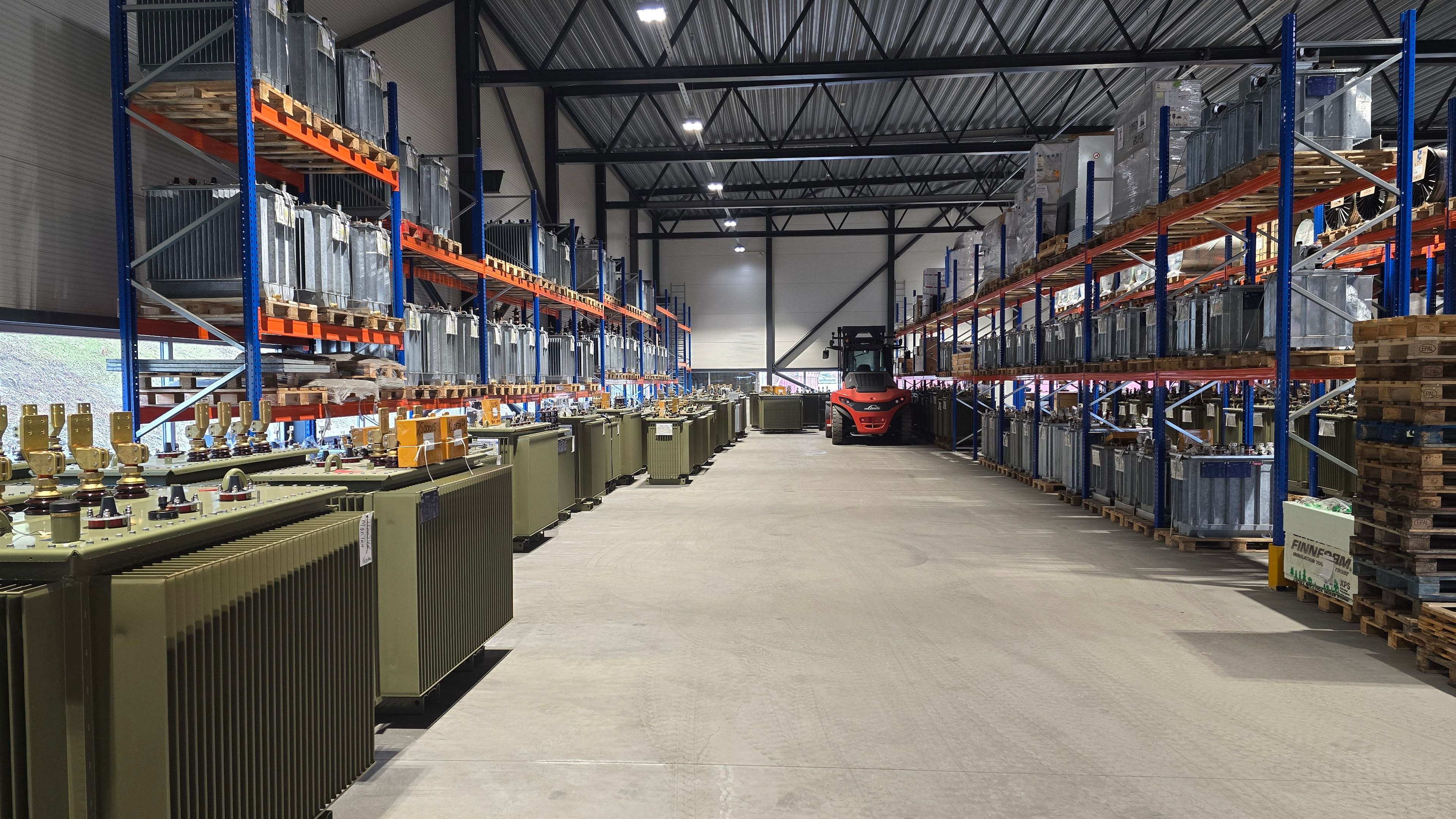
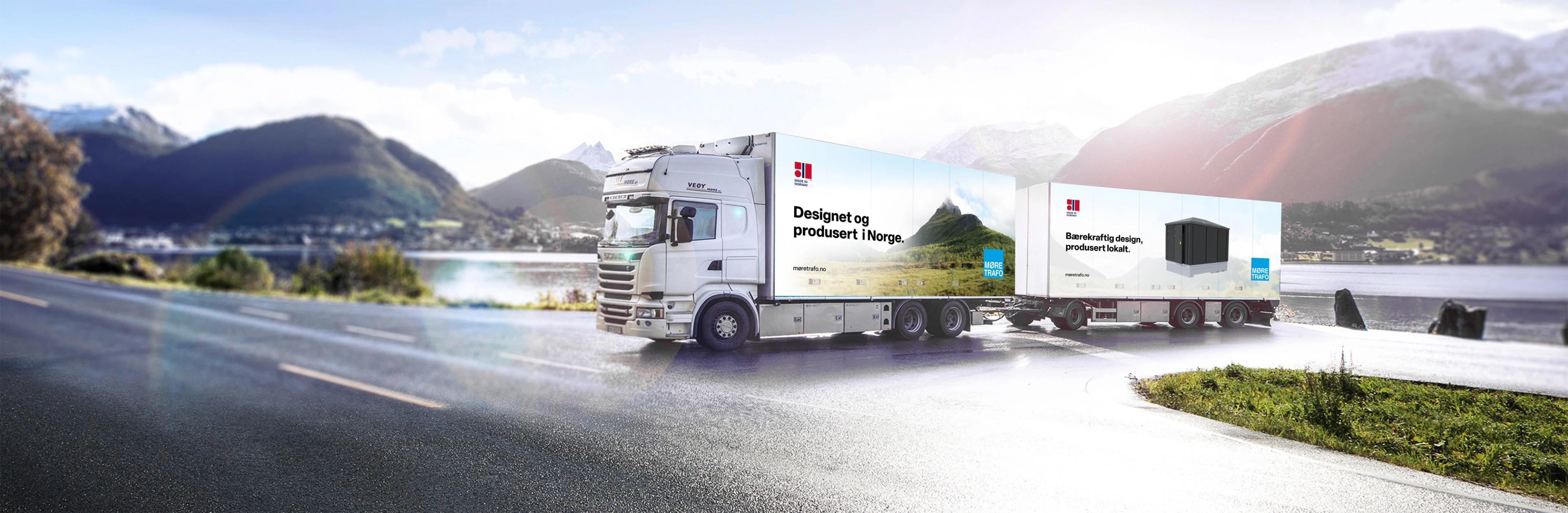
213 transformers stand ready at Møre Trafo’s contingency warehouse in Sykkylven.
213 transformers in stock – green transition with the handbrake on
213 transformers stand ready at Møre Trafo’s emergency stock in Sykkylven.
— Our impression is that the green transition is now happening with the handbrake on, and that the explanation has little to do with a lack of transformers and maxed-out production capacity, says Runar Tandstad.
213 transformers in stock
Møre Trafo has built up a relatively large emergency stock. 213 transformers are ready in the warehouse. Møre Trafo sees it as a major advantage to have an emergency stock available for customers, but expects the volume to decrease again when the construction season starts around Easter.
Deliver at Lightning Speed
— Even though we haven’t lost market share, the total market has unexpectedly declined. That’s probably closely linked to electrification and the green transition seeming to stall a bit. Since November we’ve had available capacity in our production. The first thing we did was to rebuild our finished goods inventory so we can, among other things, help customers with urgent orders, says Runar Tandstad.
With a finished goods stock, we can quickly help customers with urgent orders.
Critical shortage?
According to the article published in Teknisk Ukeblad there is a critical shortage of transformers, and the delays are due to several factors, including the war in Ukraine where a large number of transformers have been delivered, as well as the increased development of renewable energy. These factors have led to average delivery times for transformers increasing to more than two years. In extreme cases, analysts see lead times of up to four years. The shortage of transformers affects both the transformers used in the power grid and those installed directly at the power plants, according to Teknisk Ukeblad.
“They probably build too few transformers at the highest grid levels, but not for the distribution grid (11–22 kV),” says Runar Tandstad.
Slower Pace
He agrees it seems to take longer to replace fossil energy than earlier estimates suggested. Some major projects have been pushed back. Hydrogen plants and battery factories have not turned out as projected, and investors are holding back.
“We believe the pace will slow, but that it will come. Right now there is some uncertainty, but we believe that limited grid capacity and lower interest rates can trigger new investments,” says Tandstad, pointing out that there again seems to be some movement in the market for building data centers.
Streamlined Production
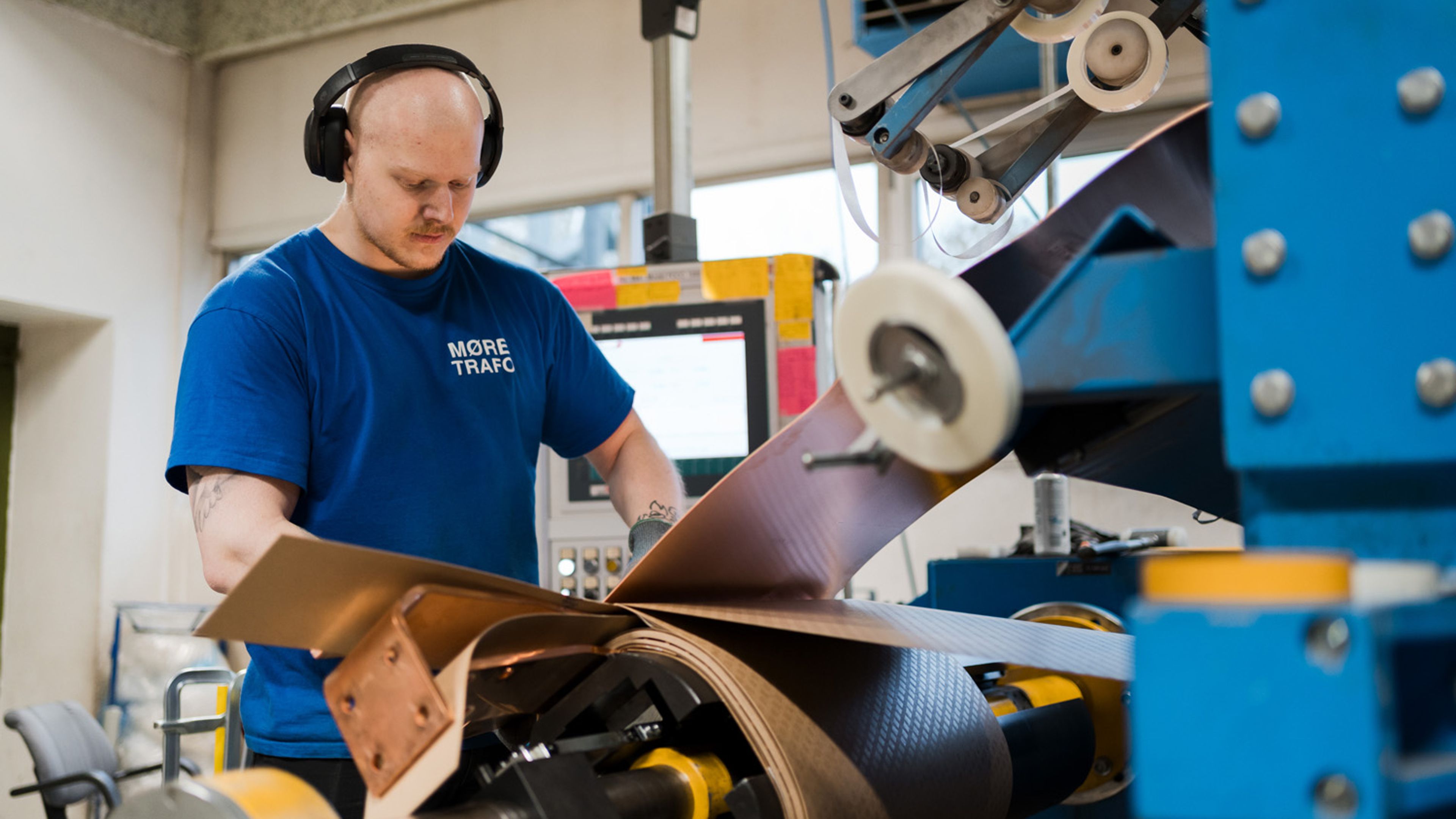
Møre Trafo has invested heavily in recent years in buildings, machinery and equipment to streamline and optimize production, and to strengthen its position as an attractive supplier to the energy industry. At the busiest, Møre Trafo had delivery times of six months. Now it is set up to deliver in six weeks.
— In 2021–2023, demand for transformers rose by 40 percent and for substations by 30 percent. And with growth forecasts pointing to higher consumption from 140 TWh today to 180 TWh in 2030, we had to act. Even though we saw a somewhat unexpected dip in demand in 2024, we still believe demand will take off again, and we are well prepared for that, says Runar Tandstad.
Thanks to our skilled employees and major investments in buildings, machinery and equipment, we can now deliver in just six weeks.
Power Grid on Borrowed Time
According to Nettavisen more than half of the transformers in Norway have exceeded their expected service life of 40–45 years, and large parts of the power grid are living on borrowed time. The replacement rate – and the willingness to replace before you have to – does not seem to be very high.
“We actually lack up-to-date statistics on this. Sintef’s last report is 13 years old, and since then many transformers have probably grown even older. Some grid companies stretch the service life as far as they can as long as the components don’t fail, and these transformers are pretty robust,” Tandstad explains when asked why the replacement rate is still so low.
Environment and Energy Requirements
What Møre Trafo cares about is that there are other and better reasons than failures to replace old transformers:
“The new transformers we build face completely new environmental and energy requirements, especially after 2016 and even more so after 2021. There are strict requirements for much lower heat loss than the old units produce. That alone should be an important reason to replace the old ones before they fail,” says Runar Tafjord.